🧪 Perc Testing in Topeka, KS
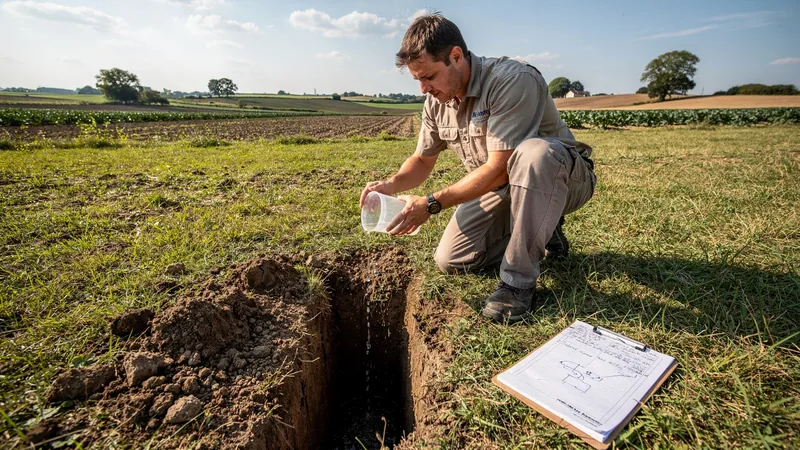
Topeka Septic provides perc testing in Topeka, KS.
Residential and Farm Septic · Flat-Rate Pricing · Free Estimates
Soil percolation testing, required before installing a new septic system, to confirm the soil can actually absorb drain field effluent.
A percolation test measures how fast water drains through the soil at a proposed drain field site, which determines whether a standard system will work or a larger/engineered system is required. Given the clay-heavy soils common across Shawnee and the surrounding counties, results vary more by specific lot than people expect, neighboring properties can come back with meaningfully different drainage. We coordinate the test with the county permitting office and give you the result in time to plan the rest of the build.
📞 Call (785) 367-2161Frequently Asked Questions
How often should a septic tank be pumped in Topeka?
Most homes in and around Topeka should pump every 3 to 5 years. Shawnee County's clay-heavy soils drain slower than sandy soils, so if you're not sure when it was last done, that's usually a sign it's overdue.
Do you service farm and acreage properties, not just in-town homes?
Yes. We service farm and acreage properties across Shawnee, Douglas, Osage, and Jefferson Counties in addition to in-town Topeka addresses.
What are the signs a septic tank needs pumping?
Slow or gurgling drains, a sewage odor near the yard or basement, soggy or unusually green patches over the drain field, and sewage backing up into a basement floor drain or tub.
How much does septic tank pumping cost near Topeka?
There is no official Topeka price list; published U.S. figures put a standard pump-out at about $295 to $610, around $375 on average; tank size and access move the price. The provider confirms the price for your property before the visit.
Does Kansas require a septic inspection before selling a house?
Not statewide. Kansas leaves septic inspection requirements to individual lenders and, in some counties, local ordinance. Many sales still need one because an FHA or VA lender, a title company, or the buyer requests it. We can schedule an inspection and get the report to whoever needs it.
What towns do you serve around Topeka?
Topeka, Auburn, Silver Lake, Rossville, Tecumseh, Osage City, Carbondale, Lyndon, Overbrook, Oskaloosa, Valley Falls, Meriden, and the farms and acreages between them across Shawnee, Douglas, Osage, and Jefferson Counties.
Do you offer emergency septic service outside Topeka city limits?
Yes, 24/7. In-town Topeka addresses usually get a truck within 90 to 120 minutes; outlying county addresses are typically same-day.
Do I need a perc test before installing a new septic system near Topeka?
Yes. Most counties in the Topeka area require a percolation test before permitting new construction or a full system replacement, to confirm the soil can absorb drain field effluent at a safe rate. We coordinate the test with the county permitting office as part of new installations.
What's the difference between a septic tank problem and a drain field problem?
The tank holds and separates waste; the drain field is where treated liquid disperses into the soil, and it's a separate system. Slow drains right after a pump usually point to the tank or a clog. Soggy ground, sewage odor outside, or unusually green grass over the field even in dry weather point to the drain field instead, and that's a different repair than a tank issue.
Who issues septic permits in Shawnee County?
For homes in unincorporated Shawnee County, private wastewater permits, site evaluations and complaints go through the county's Land Use & Development department, which since January 2026 combines the former Planning Department and the Environmental Health division (785-251-5410, North Annex, 1515 NW Saline St). Properties inside Topeka, Auburn, Rossville, Silver Lake or Willard fall under those cities instead. Outside Shawnee County, each neighboring county runs its own sanitary code.
What size septic tank does a 3 or 4 bedroom house need in Kansas?
Kansas' statewide minimum standards (KDHE Bulletin 4-2) size the tank by bedrooms: 1,000 gallons for one to three bedrooms, or 1,350 gallons with a garbage disposal, and 1,200 gallons for four bedrooms, or 1,800 with a disposal. County sanitary codes can require more than the state minimum, so the county permit is the final word. On a farm or acreage with a large household it's usually worth going one size up, especially in Shawnee County's slow-draining clay.
How far does a septic system have to be from a well in Kansas?
State rules require at least 50 feet between a private well and both the septic tank and the lateral field, and KDHE recommends 100 feet or more, because viruses and bacteria can travel farther than 50 feet in some soils. Several Kansas county codes require the full 100 feet. If you're buying an acreage with both a well and a septic system, the distance between them is one of the first things to check.
Are wastewater lagoons allowed instead of a septic drain field near Topeka?
Yes, in rural Kansas a single-home wastewater lagoon is an approved alternative where the soil won't take a lateral field, which is common in the tight clay around Topeka. A lagoon needs room: county codes set wide distances from wells, the house and neighboring homes, and it has to be fenced. It also needs upkeep: mowing the banks, keeping trees and cattails out and watching the water level. Whether you can have one, and where, is decided by the county's site evaluation.
Why is my septic alarm going off?
The alarm sits on systems with a pump tank, for example ones that pump effluent uphill to a lateral field or to a lagoon, and it means the water level in that tank is too high. Usual causes: a failed pump or float switch, a tripped breaker, a clogged pump screen, or a surge of water from laundry or rain getting into the tank. Silence the alarm, keep water use to a minimum and check the pump's breaker. If it goes off again within a few hours, call us before the tank backs up into the house.
Why is my septic system gurgling or backing up?
Gurgling drains and a toilet that bubbles when the washer drains usually mean wastewater isn't leaving the house fast enough: a tank that's overdue for pumping, a blocked outlet baffle or filter, a clog in the line between house and tank, or a lateral field that's saturated after rain. If only one fixture is slow, it's probably that fixture's drain. If the whole house is slow or sewage comes up in the lowest drain, stop using water and call for service.
My septic tank is full of water after heavy rain. What should I do?
A septic tank is always full up to its outlet pipe, which is normal. Water standing above the outlet means the lateral field can't take it, common in Shawnee County clay after a wet spell, or that rainwater is leaking in through lids, risers or cracks. Cut water use, send downspouts and sump pump water away from the tank and field, and don't pump the tank while the ground is waterlogged, because an empty tank in saturated soil can shift or float. If the level hasn't come down a few days after the rain stops, have the field checked.
Do I need septic tank additives or treatments?
For a normal household, no. The bacteria a septic tank needs come in with everyday wastewater, and the U.S. EPA notes that additives aren't needed and some can even push solids out into the drain field. What actually protects the system is pumping on schedule, keeping grease, wipes and harsh chemicals out of the drains, and spreading laundry over the week.
Is there financial help to repair a failing septic system in Kansas?
Sometimes. Through the Local Environmental Protection Program, KDHE gives counties funds that some of them use for cost-share on failed private septic systems for low and moderate income homeowners, covering things like tank or lateral field replacement when a licensed contractor does the work. Programs and deadlines change county by county and year by year, so ask the county's environmental office whether a round is open before starting a repair.